
Quick answer
FMLA leave is capped at 12 weeks within a defined 12-month period called the "FMLA leave year," and employers can choose from four methods to define it: Calendar Year, Fixed Year, Measured Forward, and Rolling Backward. The method matters because it determines when an employee's entitlement resets and whether they could potentially stack two 12-week periods back to back for up to 24 consecutive weeks off. Rolling Backward is the most common method because it's the only one of the four that prevents this stacking.
Who this applies to / Prerequisites
- Employers determining or reviewing which FMLA leave year method they use
- Employees trying to calculate how much FMLA entitlement they have remaining
- Applies to federal FMLA; some states mandate their own leave year method regardless of the employer's FMLA choice
The four leave year methods
- Calendar Year: The leave year runs January 1–December 31. Employees receive a fresh 12 weeks in a lump sum on January 1 each year. Easy to administer, but allows stacking — an employee could use a few weeks in December and a fresh 12 weeks starting the following January, producing well over 12 consecutive weeks off.
- Fixed Year: The leave year runs on a fixed 12-month period set by the employer — often the employee's hire date, sometimes the company's fiscal year. Also easy to administer, but carries the same stacking risk as Calendar Year, since entitlement resets at a fixed point regardless of when leave was last used.
- Measured Forward: The leave year starts on the first date an employee takes FMLA leave. The next leave year begins with the employee's first absence after the prior leave year is complete, at which point they receive a fresh 12 weeks in a lump sum.
- Rolling Backward: The leave year isn't fixed — it rolls with every passing day. To determine entitlement as of any given day, look back at FMLA usage in the 12 months immediately prior to that day. If less than 12 weeks were used in that trailing window, the remaining balance is available. This is the most administratively complex method, but it's the most common because it's the only one that prevents an employee from stacking two full 12-week periods back to back.
Worked examples
- Calendar Year: Carlos takes continuous FMLA leave from 12/4/24–3/25/25 (16 total consecutive weeks). He uses 4 weeks in the 2024 calendar year and 12 weeks in the 2025 calendar year.
- Fixed Year: Sue's employer uses her 2/7 hire date to start the Fixed Year. She takes continuous leave from 1/10/25–4/17/25 (14 total consecutive weeks), using 4 weeks in the first Fixed Year and 10 weeks in the next.
- Measured Forward: Rasha's first FMLA absence is 10/5/24, so her leave year runs 10/5/24–10/4/25. Her next leave year starts with her next absence after 10/4/25 — if that's 11/20/25, her next leave year runs 11/20/25–11/19/26, with a fresh 12 weeks available as of that date.
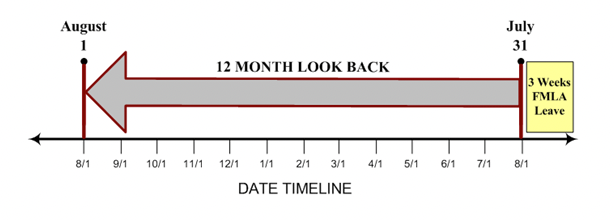
- Rolling Backward (no prior use): Rick requests 3 weeks of leave starting 8/1/25. Looking back at 8/1/24–7/31/25, he has no prior FMLA usage, so he's entitled to the full 3 weeks requested and has 9 weeks remaining.
- Rolling Backward (partial use): Maria requests 2 weeks of leave starting 11/1/25. Looking back at 11/1/24–10/31/25, she has 11 weeks already accounted for, so only 1 week is available. After using that week, her FMLA remains exhausted until 1/1/26, when the days from her original January leave begin rolling off the 12-month lookback window.
Example #1: Rick is eligible for FMLA and requests three weeks of FMLA leave to begin on 8/1/25. To determine if he has any entitlement available, we'd look at his FMLA usage for the prior year (8/1/24 - 7/31/25) to see if any FMLA leave has been used. Rick hasn't taken any previous FMLA leave, so he's entitled to the three weeks he requested and has nine more weeks available.
Example #2: Maria requests two weeks of FMLA leave for a medical procedure to begin on 11/1/25. To determine if she has any entitlement available as of 11/1/25, we'd look at her FMLA usage for the prior year (11/1/24 - 10/31/25) to see how much FMLA leave has been used (or scheduled). We find that Maria took four weeks of FMLA beginning 1/1/25, has four weeks beginning 3/1/25, and has four weeks scheduled to begin 6/1/52. In this case, she already has 11 weeks of FMLA accounted for from 11/1/24 - 10/31/25--so she only has one week available. After she takes the one week available to her in November, her FMLA will remain exhausted until 1/1/26, at which time the days of her previous January leave (which started 1/1/25) will start "rolling off" the leave year.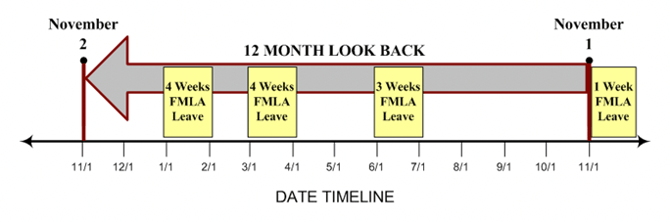
What if it doesn't work
- Employer wants to switch leave year methods: The Department of Labor requires at least 60 days' notice to all employees before the transition, and the change must be structured so employees retain the full benefit of 12 weeks under whichever method gives them the greater benefit during the transition.
- Not sure which method applies to a specific state leave: Some states mandate their own leave year measurement regardless of the employer's FMLA method. For example, Wisconsin FMLA must always operate on a Calendar Year basis, even if the employer uses a different method for federal FMLA.
- Trying to calculate remaining entitlement under Rolling Backward: Identify the 12-month period immediately prior to the day in question, total the FMLA leave used (or already scheduled) within that window, and subtract from 12 weeks.
- If none of these apply, contact your Leave Success Manager for help determining or applying your leave year method.
Limits and exceptions
- Calendar Year and Fixed Year methods both allow an employee to potentially stack two 12-week entitlements back to back, resulting in up to 24 consecutive weeks of leave.
- Rolling Backward is the only one of the four methods that prevents this stacking, which is why it's the most common choice among employers despite being the most complex to administer.
- Switching leave year methods requires at least 60 days' notice to all employees, and the transition must preserve the employee's access to the full 12 weeks under whichever method is more favorable to them during the transition period.
- State-mandated leave year methods can override an employer's FMLA choice for that state's leave program — for example, Wisconsin FMLA must always use a Calendar Year method, regardless of the employer's federal FMLA leave year selection.
Related questions
- What are the four FMLA leave year methods?
- Which FMLA leave year method prevents leave stacking?
- How much notice do we need to give before changing our FMLA leave year method?
- How do I calculate FMLA entitlement under Rolling Backward?
- Does Wisconsin have its own FMLA leave year rule?
- Can an employee take 24 weeks of FMLA leave back to back?